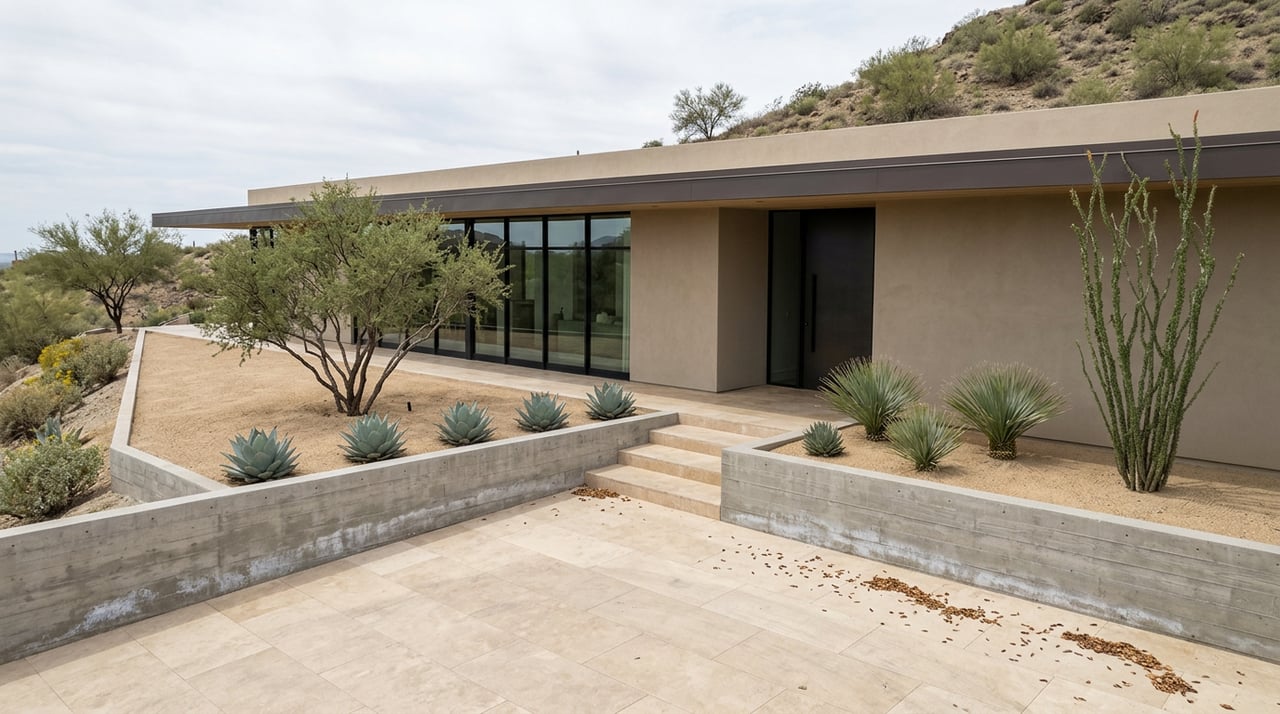
Why Paradise Valley's Median Home Price Depends Entirely on Which Site You Check
Type "Paradise Valley median home price" into a search bar and you will get an argument, not an answer. One site says the number is just over $3 million. Another puts it near $5.2 million. A third lands at $2.37 million, and a fourth reports $4.6 million for the exact same town, the same single zip code, in roughly the same stretch of 2026. None of these sources made an error. They are describing two different markets that happen to share one address.
Paradise Valley runs entirely inside one zip code, 85253, which means every home value tool, every portal algorithm, and every closed-sale tracker is drawing from the same small pool of transactions and still arriving at wildly different conclusions. That disagreement is the story. It tells a buyer or seller something that a single tidy number never could: this is a market where the median is structurally unreliable, and understanding why reveals what actually drives price here.
Here is what six separate sources reported for Paradise Valley in 2026, each with its own methodology and time window.
| Source | Time window | Reported median |
|---|---|---|
| Zillow's home-value index | Snapshot as of late July 2026 | $3.02 million |
| RealtyTrac's trailing estimate | Trailing 12 months of transactions | $3.58 million |
| U.S. News / Homelight estimator | August 2026 update | $2.37 million |
| Redfin's closed-sale median | Three months ending April 2026 | $4.6 million |
| Movoto's closed-sale median | March 2026 sold homes | $5.0 million |
| A boutique local brokerage report | May 2026 closings | Roughly $5.2 million |
That is a spread of more than $2.8 million on the same town in the same year. In most housing markets, a gap like this would suggest bad data. In Paradise Valley, it is the expected result of a market that closes remarkably few transactions relative to its price tier.
Scottsdale and Phoenix each close somewhere between 800 and 1,000 single-family homes a month. Paradise Valley closes roughly 40 to 60. When your sample size is that small, a single outsized sale does not nudge the median, it drags it.
The town has felt that firsthand twice in the past year. A Paradise Valley estate sold for $32.4 million in August 2025, a record reported at the time by the Paradise Valley Independent as the most expensive home sale in Arizona history. Less than a year later, a different estate reportedly closed for $40.24 million in July 2026, an all-cash deal that broke the record again. Either of those closings, dropped into a month with only 40-odd total sales, will pull a median upward in a way that a market closing a thousand homes a month would never notice.
This is why the same portal can report two different numbers only weeks apart. Redfin's own three-month window ending April 2026 showed a $4.6 million median, up 3.4 percent year over year. Earlier that same winter, a different snapshot from the same portal had put the figure closer to $3.7 million. The market did not lurch that far in a few weeks. The sample did.
None of this would matter as much if Paradise Valley homes were interchangeable. They are not, and the reason traces back to a zoning decision the town made when it incorporated in 1961, specifically to preserve large-lot residential character and keep Phoenix and Scottsdale from annexing the land. That founding choice still governs almost every transaction today.
Two rules do most of the work. First, a one-acre minimum lot size under the R-43 designation, meaning no tract-home subdivision has ever been possible inside town limits. Second, a floor-area ratio cap that generally holds a house to about 25 percent of its lot. Together, those two rules mean the buildable envelope on any given parcel is fixed long before a buyer ever asks about finishes or floor plan.
On sloped land, a third rule takes over. The town's Hillside Development Regulations limit how much of a lot you're allowed to disturb through grading, cutting, or clearing, and the allowance shrinks fast as the slope increases:
A steep, view-oriented lot on Mummy Mountain and a flat, walkable lot two miles away can carry the exact same acreage on paper and support two completely different homes. That is not a finish-level difference. It is a difference the town wrote into its zoning code decades ago, and it is a large part of why a single median price cannot describe both properties honestly.
The town's own sub-markets make the split visible. The Casa Blanca corridor is where the trophy tier lives, dominated by cash buyers and spec builders. Twelve homes on Casa Blanca Drive alone have sold for more than $8 million in the past three years, and one recent sale at 5641 North Casa Blanca Drive closed at $20.9 million, roughly $1,798 per square foot, in an all-cash deal.
The Camelback Country Club Estates area, anchored along the Tatum Boulevard corridor around the historic Paradise Valley Country Club, tells a different story. One-acre lots and mature landscaping sit alongside a mix of original 1960s ranch estates and significant new custom construction, so price per square foot varies enormously from one address to the next depending on which era of home you're standing in front of.
Then there is the Cheney corridor, central and flat and walkable, where 1950s and 1960s originals often sell as land value rather than house value, destined for a teardown and a new build. Town-wide, that split shows up directly in price-per-square-foot data. In May 2026, the town's blended figure ran $987 per square foot, up from $951 in April, but that blend hid a much wider range: premium hillside construction at the trophy end commanded $1,400 to $2,000 per square foot, while older homes built in 2019 or earlier, in the 3,000-to-8,000-square-foot range and priced over $3 million, closed at $795.80 per square foot between April and June 2026.
Read the median without knowing which corridor a property sits in, and you will either overpay in the softer tier or underbid in the strong one.
Most of Paradise Valley carries no homeowners association at all. The one-acre minimum and the zoning code itself do the work an HOA would handle elsewhere, which is part of why the town has stayed so architecturally consistent without a design-review board on every block.
The exceptions are the guard-gated enclaves: Clearwater Hills, Finisterre, Judson Estates, Paradise Reserve, and Azure at Ritz-Carlton. These communities carry HOA dues that fund private gate staffing and shared landscape maintenance, and they are selling something distinct from an acre of stewardship. Azure at Ritz-Carlton and Paradise Reserve in particular offer lock-and-leave configurations built for second-home buyers who want concierge-level living without the upkeep of a full estate lot. As of June 2026, rising inventory in both communities meant more selection than had existed in over a year, a genuinely different value proposition from the acre-and-privacy calculation driving the rest of the town.
None of this means Paradise Valley data is unusable, only that it needs context the headline median will never supply. Inventory told its own story in mid-2026: active listings rose sharply, pushing months of supply into buyer-favorable territory, while days on market climbed from 97 in April 2026 to 121 in May, the slowest pace in roughly a year and a half. Even that context number moves fast in a market this thin, so treat any single month's reading as a direction, not a verdict.
The more durable approach is to price by corridor and by lot, not by town. Ask which slope category a hillside parcel falls into and what percentage of the site can actually be disturbed. Compare price per square foot against homes of a similar build era in the same pocket, Casa Blanca against Casa Blanca, Cheney against Cheney, rather than against a town-wide figure built from forty or fifty closings a month.
Is Paradise Valley a buyer's market right now? Inventory and days on market both moved in a buyer-favorable direction through the spring of 2026, but with so few monthly closings, that shift can reverse quickly if even a handful of trophy properties come off the market. Treat any read on market temperature as a snapshot, not a forecast.
Why do some Paradise Valley homes have no HOA while others do? Most of the town relies on its own zoning code, particularly the one-acre minimum lot size, to maintain the character that an HOA would otherwise enforce. The guard-gated exceptions, including Clearwater Hills, Finisterre, Judson Estates, Paradise Reserve, and Azure at Ritz-Carlton, charge dues specifically for private gate staffing and shared grounds, a service the surrounding town simply doesn't need.
If you're comparing a Paradise Valley property against the number you saw online, the number is the wrong place to start. The lot, the slope, and the corridor tell the real story. Bob Martz and the team built their practice on reading those specifics rather than the headline. Request a Private Market Consultation to see what a specific Paradise Valley address is actually worth once the zoning math, the corridor, and the comparable sales are laid out side by side.
This article is general information, not legal, tax or financial advice. Consult a qualified professional about your situation.
Stay up to date on the latest real estate trends.
With experience and expertise in multiple facets of the business have given us the skills to deal with any transaction, regardless of the type or price point.
BOB MARTZ
4222 N Marshall Way Ste A Scottsdale AZ 85251